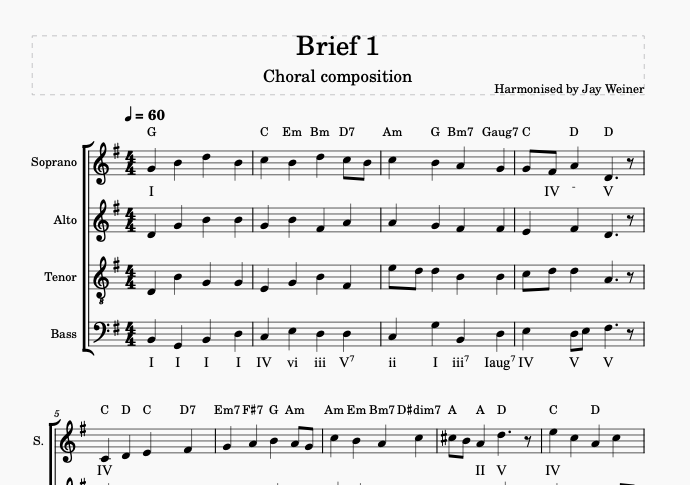
I chose Brief 1 because of my experience with choir music – I figured it would be the easiest one to execute decently.
I was right, but I still had to give myself a few crash courses to get the finished product. I had to learn better chord identification, how a Bach chorale works, and expand my knowledge on cadences a bit, as well as re-learn Musescore as last time I’d used the programme was in S2.
The assignment was to write a four-part STAB harmony on the basis of a melody on the soprano and a few mandatory cadences.
This is the final result :
The process
I copied the Brief into Musescore, I set the instruments to piano to hear the harmony better (and to avoid musescore digital choir voice induced psychosis), and I started harmonising the voices:
I worked out of order – I started with the mandatory cadences and then I filled in the gaps. I saved many versions – 16 in total, until I had the sound that I wanted.
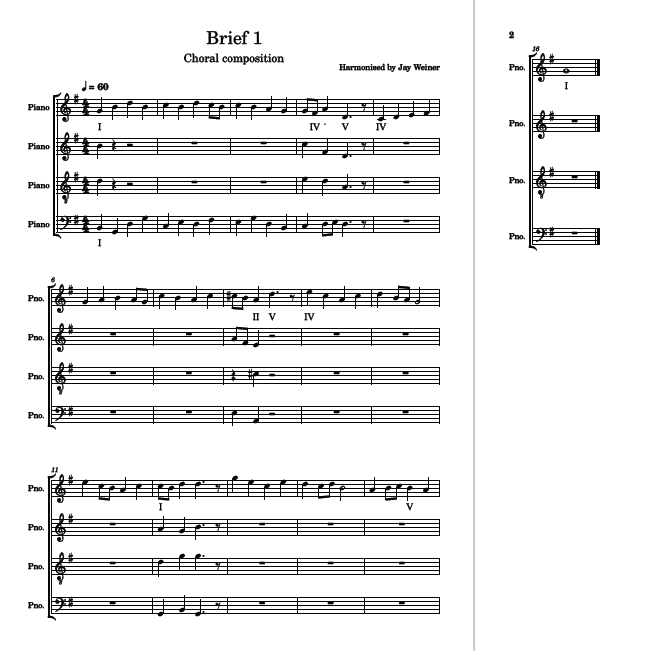
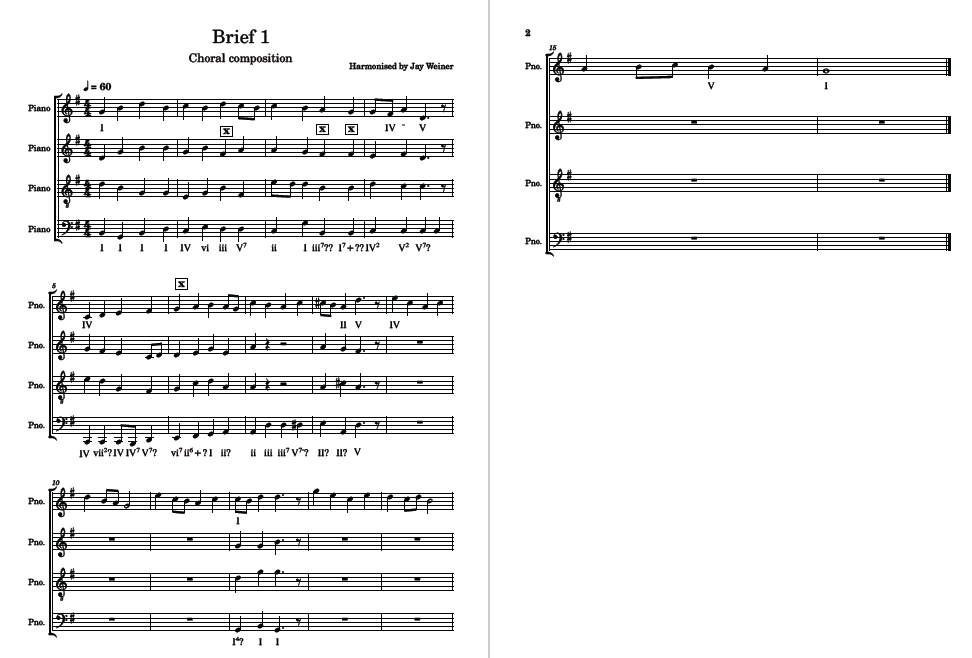
I wrote the grades and the chords and listened and corrected mistakes in several rounds. It was mostly trial and error after I’d blocked in the basic chords I wanted.
I wanted it to sound rather dissonant, and not necessarily in baroque style, but I had the constraints of the soprano melody and the mandatory cadences. So I used theory on how to harmonise a Bach chorale as a basis throughout the score, but i also explored what i thought would sound good beyond that.
Bars 5 and 6 were initially very loosely inspired by a specific passage of Optimistic by Radiohead, as when i was listening to the soprano line the long scale reminded me of it, so i decided i wanted to do something cool with that bit. In the end its not very different from the rest but i am quite happy with it.
The whole time, one of the hardest things i had to contend with was the range of the soprano line – the “soprano” was singing in more of an alto register nearly the whole time, which gave me extremely limited wiggle room in the alto and tenor sections, often not being able to really chose which inversion of a chord i wanted because i couldnt put the altos higher than the soprano, but they were already too low to go lower etc.
I listened to all voices separately and tried to make coherent melodic lines.
Towards the end of the process, I changed the instruments back from piano to choir voices, using first the default voices, and then a sound library that I downloaded from MusicHub. I then realised how comically low I’d put the basses and had to go through some real choral music to establish their range, and move anything that was outside of that up the octave. I also had to edit some of the tenor parts for a similar reason. This kind of affected some of the chords, but I tweaked those bits to sound good nonetheless.
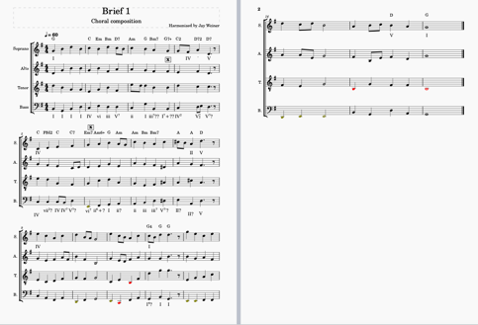
I did not have that problem with soprani and alti, because I can sing those lines and so have a better idea of their realistic ranges. Fortunately, Musescore highlights in grey and red the ‘difficult’ and ‘impossible’ notes, outside normal range, so it made the process quite easy, even if i hadn’t looked through St Matthew’s Passion just to make sure.
I cleaned up the chords that sounded too strange, and fixed a couple of places where the voices crossed. Playing the chords in Musescore helped fixing the problems.
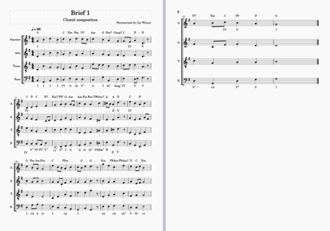
version 16 – the final one! After many iterations, I rewrote the chords after the changes and added all the harmonic grades.
Tools
These are the tools that I used:
- Musescore Studio
- MuseHub
- The Choir sound library in Muse Sounds: Muse Choir (symphonic choir)

Leave a Reply