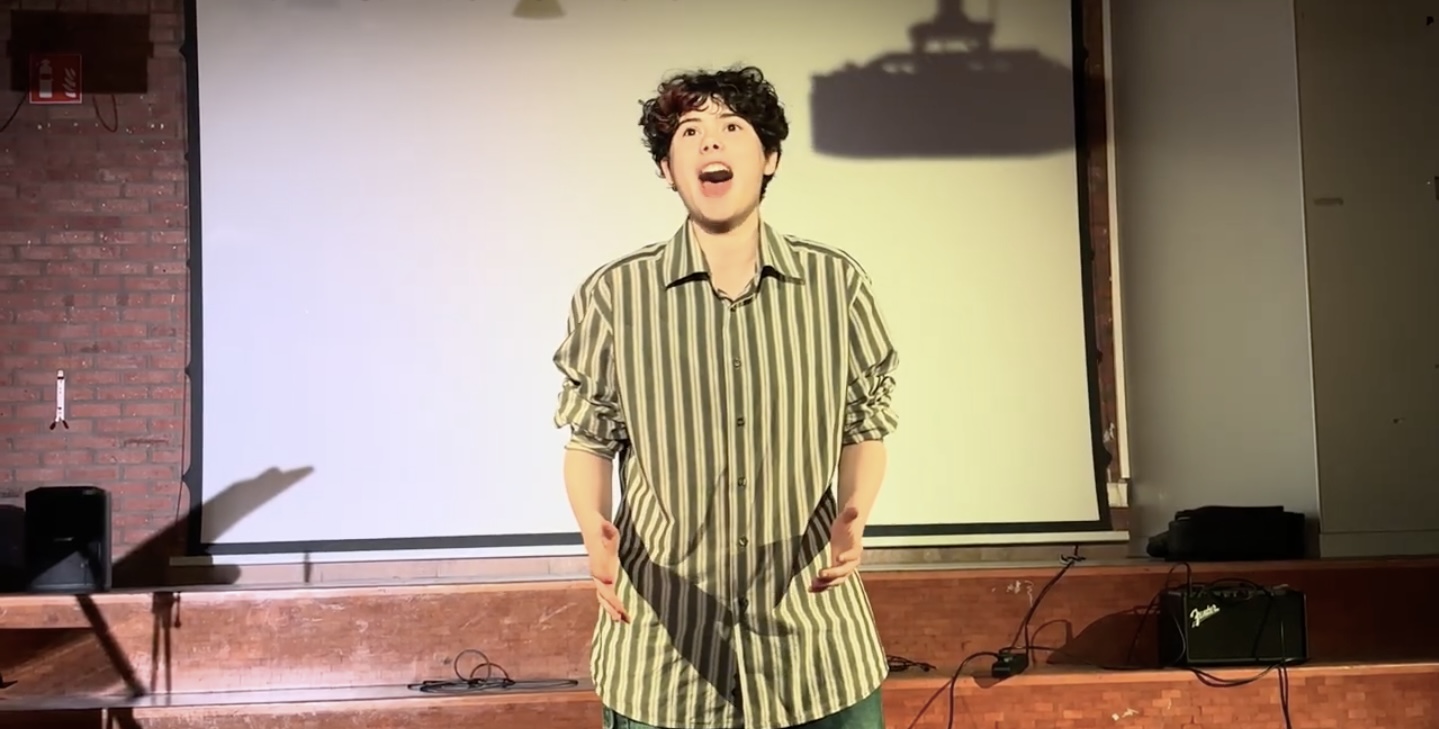
On the 4th of February 2026, my music class performed at our pre-bac concert, in which we each performed two pieces of contrasting styles. To choose my pieces, I considered a few genres but ultimately decided to go with two lyrical pieces as that’s where my skills lie. I performed “Erlkönig” by Franz Schubert and “Music for a While” by Henry Purcell.
More than a century, and half a continent, separate these two vocal masterpieces, written by two great composers who died young, leaving a lasting legacy. ‘Music for a While’ is a perfect example of the calm English Baroque style; ‘Erlkönig’ is a frenetic burst of German Romantic drama.
These two songs are highly contrasted in tempo, mood, language, and style, but they also have a fair few things in common. Firstly, they share a distinct theatrical character, although neither of them is an opera aria – both songs talk about death, are based in old legends, and feature supernatural creatures. Both include characteristic, mantra-like, and repetitive bass lines (in Purcell’s case, a basso continuo), independent from the singing melody.
Also, unlike other art songs or arias, characteristically sung by only one type of voice, these two have been performed by singers of all voice types. A quick search on Spotify or YouTube will find you dozens of versions of each, in different key signatures, from low baritone to the highest coloratura soprano, even in strange configurations, like multi-voice a capella harmonisations or Heavy-Metal covers. Nevertheless, for different reasons, they were both conceived with a purer, high voice in mind.
“Music for a while”, originally composed by Purcell in the 17th century for a countertenor, is a well-known example of the English Baroque period. The song was added in 1692 as “incidental music” or “masque” to the third act of the existing theatrical play Oedipus, by John Dryden, based in Greek mythology and freely deviating from the original plays by Sophocles.
This is essentially a lullaby for a Fury. A priest summons King Laius back to life using music to pacify Alecto – one of the Furies similar to Medusa with snakes on her head -, so she falls asleep and the dead can be freed. The famous, hypnotic melody develops in the high register over a basso ostinato (“stubborn” repetitive bass line – like a walking bass in modern music) with ascending, walking scales representing the ascension of the king from death to life. One can also hear the nine snakes dropping from Alecto’s head in descriptive voice jumps of the word “drop”, in a technique typical of Baroque music called “word painting”.
I am a soprano, so I sing the song in A minor, which is higher than the original key.
“Erlkönig”, “the Erlking”, “Elf-King”, or King of the Fairies, was the first piece ever composed by Franz Schubert – his Opus 1 – and one of his most famous ones. The lyrics are a famous poem by Goethe based on a Nordic legend, which Schubert put in music in 1815, when he was 17 or 18 years old.
Schubert wrote the original lied (art song, in German) for a high voice, which arguably is the most adequate to portray the pure voice of a child screaming. However, like many lieder, it was transcribed for medium and lower voices, quickly becoming very popular among baritones, admittedly more apt to play the child’s father.
In the poem, four different characters speak, and the originality of the song is that the four must be sung by a solo singer: a father, singing in the singer’s lower register and trying to calm his feverish child whilst bringing him home on his horse; his son, singing increasingly high, as he becomes more and more agitated by supernatural visions; the evil Elf King, invisible to the father, harassing the child with promises and threats; and the narrator, who tells the story using the medium voice register… plus a sort of fifth character, the father’s horse, whose furious galloping is portrayed by the piano in an extremely difficult kind of ostinato made of fast triplets.
The dramatic tension and the sense of danger increases until the rider gets home, the piano/horse slowing its pace and eventually stopping, only too late, as the narrator tells us that the child has died in his father’s arms.
I found my performance of “Erlkönig” to be the best I’ve ever done – I managed to portray the shifts in characters in a way I really like, and didn’t struggle on any notes. This isn’t to say there were no flaws – my breath control is still quite poor, and I don’t have proper control of my vibrato, but overall I’m extremely happy with my performance.
“Music for a While” however, I found I sang relatively mediocrely. I think I wasn’t focused enough yet – this was my opening piece – , and that resulted in a pretty flat rendition of the piece. While I wasn’t egregiously wrong on anything, I ran out of air quite severely at one point, and my voice wasn’t on point (too much air and it felt strained).
Nevertheless, I scored 10/10 overall.

Leave a Reply