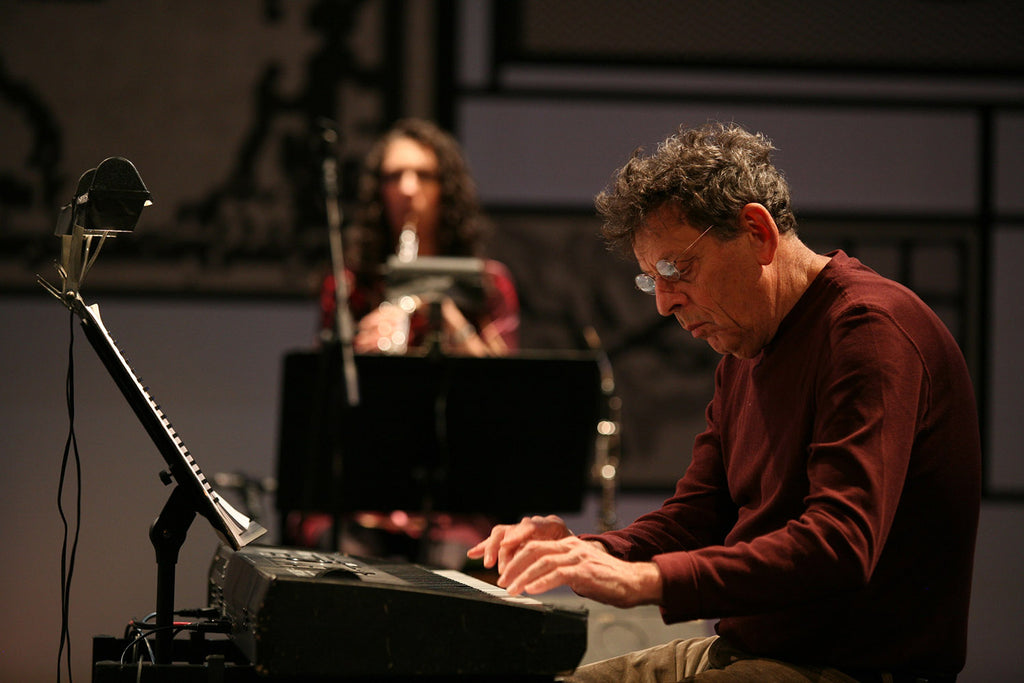
American minimalism emerged in the late 1950s and early 1960s as a radical departure from the complexity of serialism and European avant-garde traditions. But long before the genre “officially” appeared in the 1960s, a handful of composers were already setting up its groundwork. Erik Satie, working between the 19th and 20th centuries, offered a level of simplicity and mystic originality that was virtually unheard of at the time. His early works like Gymnopédies and Gnossiennes broke from the ornate expressiveness of Romanticism, favouring stillness over drama. Street performer and poet Moondog brought another vital thread to the pre-minimalist tapestry, blending jazz, field recordings, and Renaissance music in a way that would directly inspire Philip Glass and Steve Reich. But it was John Cage who most radically prepared the ground, introducing indeterminate music and the role of chance into composition – ideas that would become central to the minimalist project a decade later.
When minimalism properly emerged, it did so with four key figures at the helm. La Monte Young was the first to place droning, sustained tones at the heart of his compositional process, generating a hypnotic effect enriched by Eastern musical influences. Terry Riley pushed further, experimenting with delay systems and tape music to create work so unpredictable it seemed to escape the composer’s control entirely. It was Philip Glass and Steve Reich, however, who gave the movement its defining architecture – reducing materials to a minimum and building evocative soundscapes through phasing patterns, repetitive loops, and diatonic harmonies that sharpened the listener’s perception rather than dulling it. Over time, composers also drew on Indian ragas and African percussion, dissolving the boundary between Western classical tradition and the wider musical world.
By the mid-1970s, minimalism had crossed into the mainstream through composers like Brian Eno, Arvo Pärt, Michael Nyman, and John Adams – each extending the form into ambient music, film scoring, and orchestral writing. In recent decades, the genre has branched out even further. William Basinski used decaying tape loops to create time-worn soundscapes. Artists like Murcof merged together classical minimalism and Detroit techno, while Jon Hopkins branched further into electronic music with the genre.

Leave a Reply